


The Fear of Not Being Enough — And What I've Learned to Do With It

I was listening to a podcast when the interviewer asked their guest a question that stopped me cold.
"What are you afraid of?"
I set down my phone and lay there in the dark, asking myself the same question. Images from across my life came forward in a matter of seconds — moments I hadn't thought about in years, some I thought I'd dealt with, some I clearly hadn't.
My answer came quickly and it surprised me with how certain it was.
I am afraid of not being enough.
Not smart enough.
Not fit enough.
Not healthy enough.
Not masculine enough.
Not outgoing enough.
Just — not enough.
And then I started tracing it back. How far did that feeling actually go?
Further than I expected.
Where It Started
I was held back in grade 2.
I was an energetic kid with a short attention span and some trouble with reading and math. Watching every friend I had move forward into the next grade while I stayed behind — that was the first time I remember feeling that specific weight.
The weight of being behind. Of not measuring up. Of something being wrong with me that wasn't wrong with everyone else.
Not long after, I spent stretches of my childhood in and out of hospitals.
A ruptured appendix in grade 3.
A blood disorder that took until grade 10 to stabilize.
I remember lying in hospital beds asking myself why I couldn't just be healthy like the other kids.
Grade 6. Standing at a bus stop, desperate, apologizing to friends for being "annoying and girly" and telling them I could change.
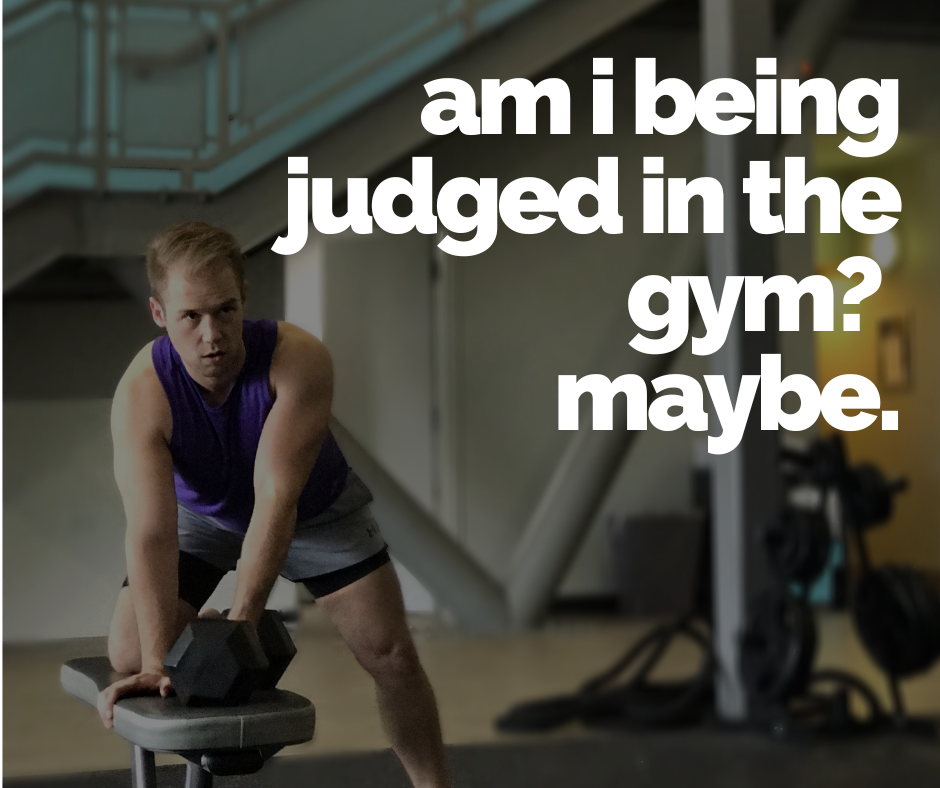
I was an easy target through junior high — the kind of kid who got picked last in gym class, who cringed at team selection because it always confirmed what I already suspected about myself.
Then drama class in high school. Talking about career paths after graduation. A classmate looked at me and said, with complete confidence:
"I don't think you could be a personal trainer. People aren't going to want to be trained by you. You're not fit enough."
I tried to shake it off. And then I graduated, started training clients and received an email from a complete stranger — someone who had seen my name in an ad — telling me I'd probably get more clients if I lost weight.
For a moment — just a moment — I went back to that drama classroom and wondered if he'd been right.
He wasn't. But I went there.
Why I'm Telling You This
I've been a personal trainer in Edmonton for over 15 years. The majority of my clients are in their 50s, 60s and 70s. And I can tell you — with complete confidence — that the fear of not being enough does not disappear with age.
If anything, it gets more complicated.
At 60, it's not just about being fit enough or smart enough. It's about whether you've done enough with your life.
Whether you're still relevant.
Whether your body is failing you in ways that feel like personal shortcomings rather than just biology.
Whether starting something new — a fitness program, a new habit, a new chapter — is even something people your age are allowed to do.
I watch people walk through my door carrying decades of that feeling. The woman who spent her entire adult life being told she should be smaller.
The man who retired and suddenly doesn't know who he is without the career that defined him.
The person who had a health scare and now feels like a stranger in their own body.
The fear of not being enough wears different clothes at different stages of life. But underneath, it's the same feeling it was in grade 2.
And it deserves to be addressed — not suppressed, not performed away, not fixed with a diet plan. Actually addressed.
Here's what I've learned — from my own work and from watching hundreds of people do theirs.
1. The Comparison Will Always Beat You
When the feeling of not being enough surfaces, it almost always has a reference point. Someone you're measuring yourself against — consciously or not. Someone who seems further along, more capable, more put-together, more whatever-it-is-you're-afraid-you're-not.
Here's the problem: you're comparing your internal experience to someone else's external presentation. You know every doubt you have, every failure, every hard morning.
You see only their highlight reel.
It's a fight you will never win because it's not a fair fight.
The only comparison worth making is between who you are today and who you were six months ago.
That's a real measurement.
Everything else is noise.
2. The Hurt Has to Go Somewhere
Here's something I learned the hard way: if you don't deal with the hurt, it deals with you.
The moments that created the feeling of not being enough — for me, the hospital beds, the bus stop, the drama classroom — I didn't actually process most of them at the time.
I moved on. I got tougher. I built a life.
But those moments didn't disappear. They went somewhere. And they came out in impatience, in defensiveness, in moments where I was harder on the people around me than the situation called for.
Your body keeps score. The things you don't deal with don't dissolve — they resurface.
Sometimes in a random moment of frustration.
Sometimes in the way you talk to yourself after a bad workout or a week where you didn't eat well or a day where you felt like you'd slipped back to square one.
Dealing with the hurt doesn't mean reliving every difficult moment. It means acknowledging what happened, giving it the weight it deserves and making a conscious choice not to let it keep running the show.
That work is harder than any training program I've ever written.
It's also more important.
3. Most People Aren't Thinking About You Nearly As Much As You Think
This one is uncomfortable to hear but genuinely freeing once it lands.
Most of the time, when we take something personally — a comment, a look, a perceived slight, it had very little to do with us.
The drama class kid who told me I wasn't fit enough to be a trainer wasn't delivering a well-researched verdict on my potential. He was a teenager saying something thoughtless, probably not even aware of the impact.
The stranger who emailed me about my weight? That email said everything about where he was and nothing about who I was.
When we stop taking everything personally — when we start seeing other people's comments as reflections of their own experience rather than facts about ours — we free up an enormous amount of energy.
Energy that was being spent on defense, on rumination, on trying to prove something to people who weren't even paying that much attention.
You're allowed to let it go.
Most of it was never yours to carry.
4. The Hard Stuff Becomes the Foundation
I want to be careful here because this can sound dismissive if it's said too quickly.
I'm not going to tell you that everything happens for a reason or that your pain is secretly a gift. Sometimes hard things are just hard.
In 2015 I became aware I was being included in a string of malicious messages from former colleagues. The messages were designed to hurt someone — and my sexuality was the weapon they chose to use.
Being a gay man wasn't the target. I was just the instrument. I won't pretend that didn't land hard. It did.
Having something that personal used as ammunition — by people I'd worked alongside, was its own specific kind of hurt. But I credit every hard thing that came before it for what happened next.
I walked into that boardroom. I sat across from those people. I said what needed to be said, clearly, without flinching. Not because I wasn't affected, but because I'd been building that backbone for a long time without knowing it.
That's what the hard stuff does when you let it. It doesn't make you immune. It makes you sturdy.
What I will tell you is what I've observed in my own life and in the lives of the people I've worked with — is that the experiences that felt most like setbacks often became the most important building blocks.
The years in hospital beds gave me an understanding of what it feels like to have your body betray you. It makes me a better coach to people who are navigating health challenges and feel like strangers in their own bodies.
Being picked last in gym class gave me a bone-deep understanding of what it feels like to walk into a fitness space and not believe you belong there. Every client who feels that way — I know exactly where they are. I've been there.
The drama class comment, the email, the moments of feeling like I wasn't enough — all of it built something in me that couldn't have been built any other way. Not strength in the gym sense. Resilience.
The kind that makes you get back up not because you're fearless but because you've learned you can survive the fall.
That's available to you too.
Whatever you've been through — it's not wasted. It's working.
5. You Are Not a Category
You are not your health history. You are not your fitness level. You are not your age, your size, your diagnosis, your past attempts or what someone said about you in a drama class twenty years ago.
You are a specific, unrepeatable person with a specific combination of experiences, strengths, and capacities that has never existed before and will never exist again.
That's not motivational poster language.
That's just true.
Eight billion people on this planet. Not one of them is you. That's worth something.
That's worth quite a lot, actually.
The fear of not being enough is real. I'm not going to tell you it goes away completely.
What I can tell you is that it gets quieter the more you stop waiting for external validation to answer it — and start building something that answers it from the inside.
For me, that something has always been fitness.
Not because it makes you look a certain way.
Because of what it teaches you about yourself in the process.
You show up when you don't feel like it.
You do the hard thing.
You get stronger.
You find out, repeatedly, that you're more capable than you thought.
That's the work.
And it's available to you at any age, at any starting point, in any body.
You're enough to start. You always have been.
Every rep matters.
[Book a free intro call with Shane →] Here
[Download: 5 Things I Wish Every New Client Over 55 Knew Before We Started →] Here

Comments